
The Immaculate Conception
A Singular Grace in the Story of Salvation
What is it, really?
This doctrine is foundational for millions of Christians, yet it remains one of the most misunderstood. Before we dive deeper, let us clear up the most common confusion.
Common Misconception:
The Virgin Birth
Many believe the Immaculate Conception refers to Jesus being conceived in Mary's womb by the Holy Spirit. That is a separate miracle entirely!
The Actual Doctrine:
Mary's Conception
This doctrine is about Mary's conception in the womb of her mother, St. Anne. God protected Mary from the stain of Original Sin from the very first instant of her existence.
The Nature of the Gift
"In the first instance of her conception... she was preserved free from all stain of original sin."
— Pope Pius IX, 1854
In that hidden moment when her life began, Mary was preserved from the spiritual defect that afflicts the rest of humanity. It is a story not just about Mary, but about the absolute victory of God's grace.
Understanding the "Stain"
To understand this gift, we must understand what Mary was saved from. Original Sin is not a bad act we commit. It is a state we inherit.
When Adam and Eve turned from God, they lost the gift of "Original Justice" which included sanctifying grace. As their descendants, we inherit a human nature that is good but spiritually empty. We are born without the life of God in our souls. This lack of grace creates a disorder within us called concupiscence (or disordered desires), where our passions rebel against reason.
The Unique Exception
The Immaculate Conception means that Mary was the sole exception to this rule of transmission.
At the exact moment her soul was created and infused into her body, God intervened. Instead of finding a soul empty of grace, the Holy Spirit filled her with sanctifying grace. She stood in the same spiritual state as Eve before the Fall. She was fully human, yet perfectly free from the internal tug of sin, prepared to be the holy vessel for God Himself.
The Protoevangelium
The Promise of Absolute Enmity
The roots of this dogma go back to the very beginning, in Genesis 3:15. After the Fall, God speaks to the serpent (Satan) and promises a future victory:
"I will put enmity between you and the woman, and between your offspring and hers; he will strike at your head, while you strike at his heel."
The Church sees "The Woman" as Mary. The key word here is enmity, which means total opposition or hostility. If Mary had ever been touched by sin, even for a moment, she would have been under the power of the serpent. For the enmity to be absolute, and for the victory over the serpent to be complete, the Woman must be entirely free from his dominion.
The Greeting
"Full of Grace"
In Luke 1:28, the Angel Gabriel greets Mary with a title rather than a name: "Hail, full of grace."
Kecharitomene
This is the original Greek word used. It is a "perfect passive participle," which is a fancy grammatical way of saying it describes a past action with a permanent result.
The angel is essentially calling her "She who has been completely perfected in grace." It implies this was her state from the very beginning.
- Passive Voice: The action was performed by God; Mary is the recipient of this unique transformation.
- As a Title: The angel uses this word to define her identity. Her very name in the eyes of Heaven is "Full of Grace."
The Patristic View
The New Eve
The Early Church Fathers, such as St. Irenaeus (c. 180 AD), saw the history of salvation as a "recapitulation." What went wrong with the first Eve had to be set right by the New Eve.
The Parallel: The first Eve was created immaculate (without sin) but fell into disobedience. Mary, the New Eve, was also created immaculate but remained faithful.
"The knot of Eve's disobedience was loosed by the obedience of Mary." — St. Irenaeus
The Logic: For this parallel to work, the "New Eve" cannot be inferior to the "First Eve." If the first Eve began life without sin, it is essential that the woman who restores life also begins her existence without the stain of sin.
The Eastern Tradition
Panagia: The All-Holy
While the West debated the technicalities of "Original Sin," the Christian East simply called Mary the Panagia, the "All-Holy." This ancient title implies a holiness that is total, complete, and uninterrupted.
St. Ephrem the Syrian, a great voice of the East in the 4th century, wrote of Mary's absolute purity: "Thou alone and thy Mother are in all things fair, there is no flaw in thee." This confirms that the belief in Mary's sinlessness is not just a Western invention, but a universal truth held by the ancient Church.

The Analogy
The New Ark of the Covenant
In the Old Testament, the Ark held God's word on stone. God commanded it be made of "incorruptible wood" and covered in pure gold. It had to be perfect to hold God's presence.
Mary is the "New Ark" because she carried Jesus, The Word of God and God in the flesh. If God required a wooden box to be pure to hold stone tablets, logic suggests He would create a vessel that was absolutely perfect to carry His own Son.
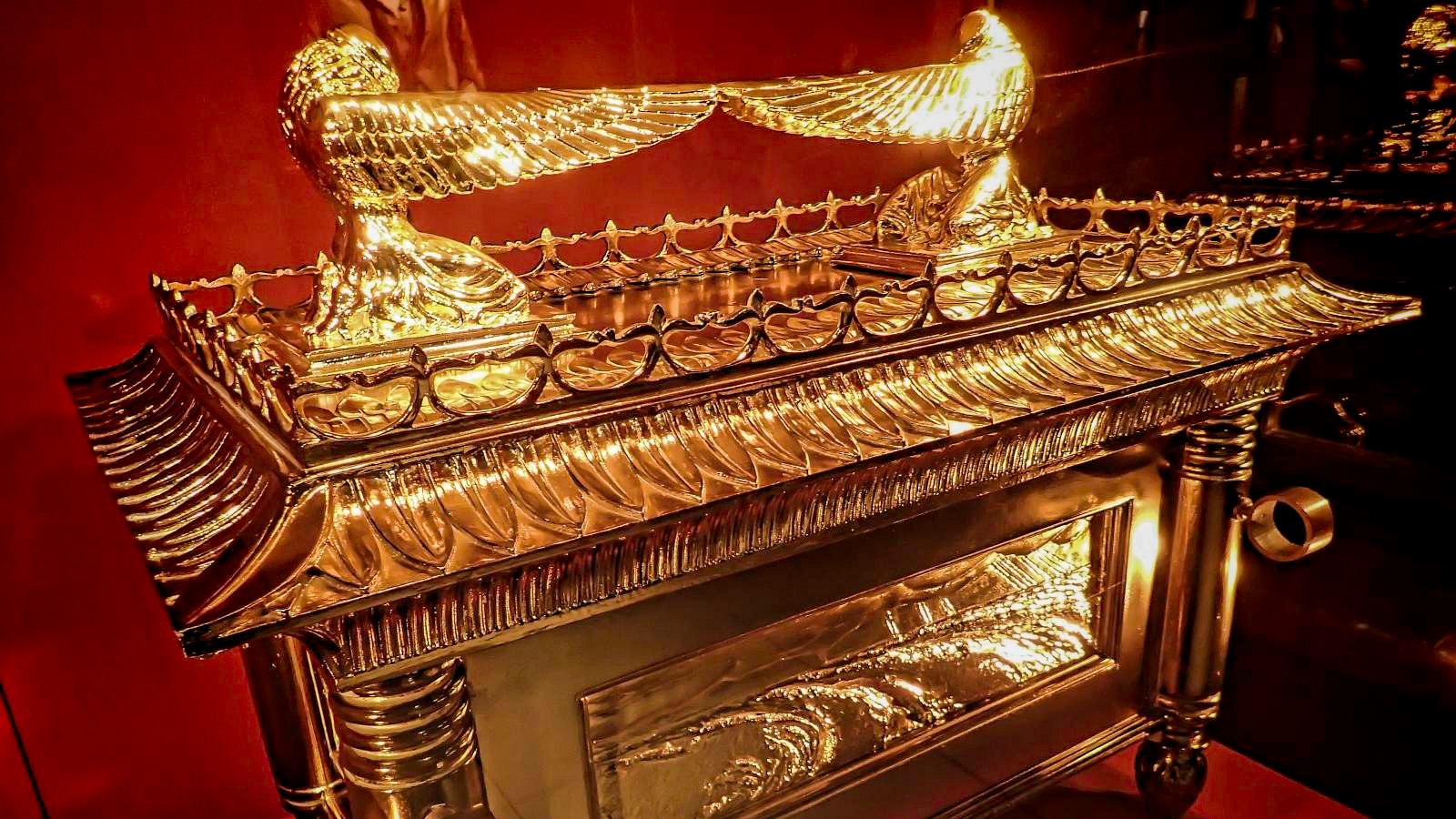
The Ark was built to precise divine specifications.
The Great Logical Argument
Solving the Puzzle
For centuries, theologians debated this. How could Mary be free from sin if everyone needs a Saviour? The breakthrough came from Duns Scotus in the Middle Ages. He proposed a simple Latin argument: Potuit, Decuit, Ergo Fecit.
1. Potuit (He Could)
God is all-powerful. Creating a human being without original sin is definitely within His power.
2. Decuit (It Was Fitting)
It makes perfect sense that the Son of God should have a mother who is a completely pure home for Him.
3. Ergo Fecit (Therefore He Did)
Because God could do it, and because it was the most fitting thing to do, it is logical to conclude that He did it.
Did Mary Need a Saviour?
Absolutely. Mary refers to God as her Saviour in scripture. But her salvation was unique. It is called Preservative Redemption.
Think of it this way: You can save someone by pulling them out of a deep pit (that is how we are saved). Or, you can save someone by preventing them from falling into the pit in the first place. That is how Mary was saved.
By nature, as a human, Mary faced the "Debt of Sin"; she should have contracted it. But God intervened. He applied the merits of Jesus' death on the cross to Mary outside of time, at the moment of her conception. She was saved by Jesus just as we are, but in a "more sublime manner."
A Confirmation from Heaven
In 1858, just four years after the Pope officially defined the dogma, a young girl named Bernadette Soubirous saw a vision of a Lady in a grotto in Lourdes, France. When Bernadette asked the Lady for her name, she did not say "I am Mary."
Instead, she looked to heaven and said: "I am the Immaculate Conception."
This profound statement revealed that this grace was not just something Mary had; it was who she is. She is the perfect example of what a human being looks like when completely filled with God's life.

The Theological Puzzle
The Paradox of Free Will
This brings us to a fascinating puzzle: If Mary was preserved from sin, was her famous "Yes" to God just a pre-programmed response? Did God's special intervention turn her into a divine puppet?
The answer lies in understanding what "freedom" really means. For most of us, free will feels like a constant tug-of-war between our desire for good and our internal pull toward selfishness. We often think freedom is just the ability to choose between good and evil.
Freedom Without "Static"
The grace given to Mary didn't erase her humanity; it perfected it. It removed the "internal static" of sinful inclinations. Her will wasn't constrained; it was liberated.
Because she lacked that internal conflict, she could see God's will with perfect clarity. Her choice was not automatic; it was the ultimate, most profound act of human free will possible, a choice made without the division that affects the rest of us.
"To become the mother of the Saviour, Mary 'was enriched by God with gifts appropriate to such a role.' ... In fact, in order for Mary to be able to give the free assent of her faith to the announcement of her vocation, it was necessary that she be wholly borne by God’s grace." — CCC 490-491
The Bigger Picture
Four Dogmas, One Story
The Immaculate Conception does not stand alone. It is part of a "mosaic of faith." The Church teaches four great truths about Mary, and they all fit together to reveal God's plan.
1. Mother of God
The Mission. This is the foundation of everything. Because God chose Mary to be the mother of His Son, He needed to prepare her. The dignity of her Son required a mother of perfect holiness.
2. Immaculate Conception
The Preparation. To get ready for that mission, God preserved her from all sin. The Immaculate Conception is the "beginning" of the story, the creation of the perfect vessel.
3. Perpetual Virginity
The Dedication. Mary belongs entirely to God. Her virginity is the physical and spiritual sign of her total "Yes" to Him. She reserved her entire self, body and soul, for Jesus alone.
4. The Assumption
The Destiny. Because she was Immaculate (free from sin), she was free from the corruption of the grave. At the end of her life, she was taken up body and soul into Heaven, showing us our own future destiny.
Why Does This Matter?
She is the Eschatological Icon, the image of our own future.
The Immaculate Conception is not meant to put Mary on a distant pedestal where we cannot reach her. Instead, she is the "Archetype of the Church." She shows us the absolute peak of what God's grace can do.
God's ultimate dream is for all of us to be "without spot or wrinkle" in Heaven. By looking at Mary, we see our own destiny. If God did this for one person at the beginning of the new creation, it gives us hope for the final victory He has planned for all of us.