
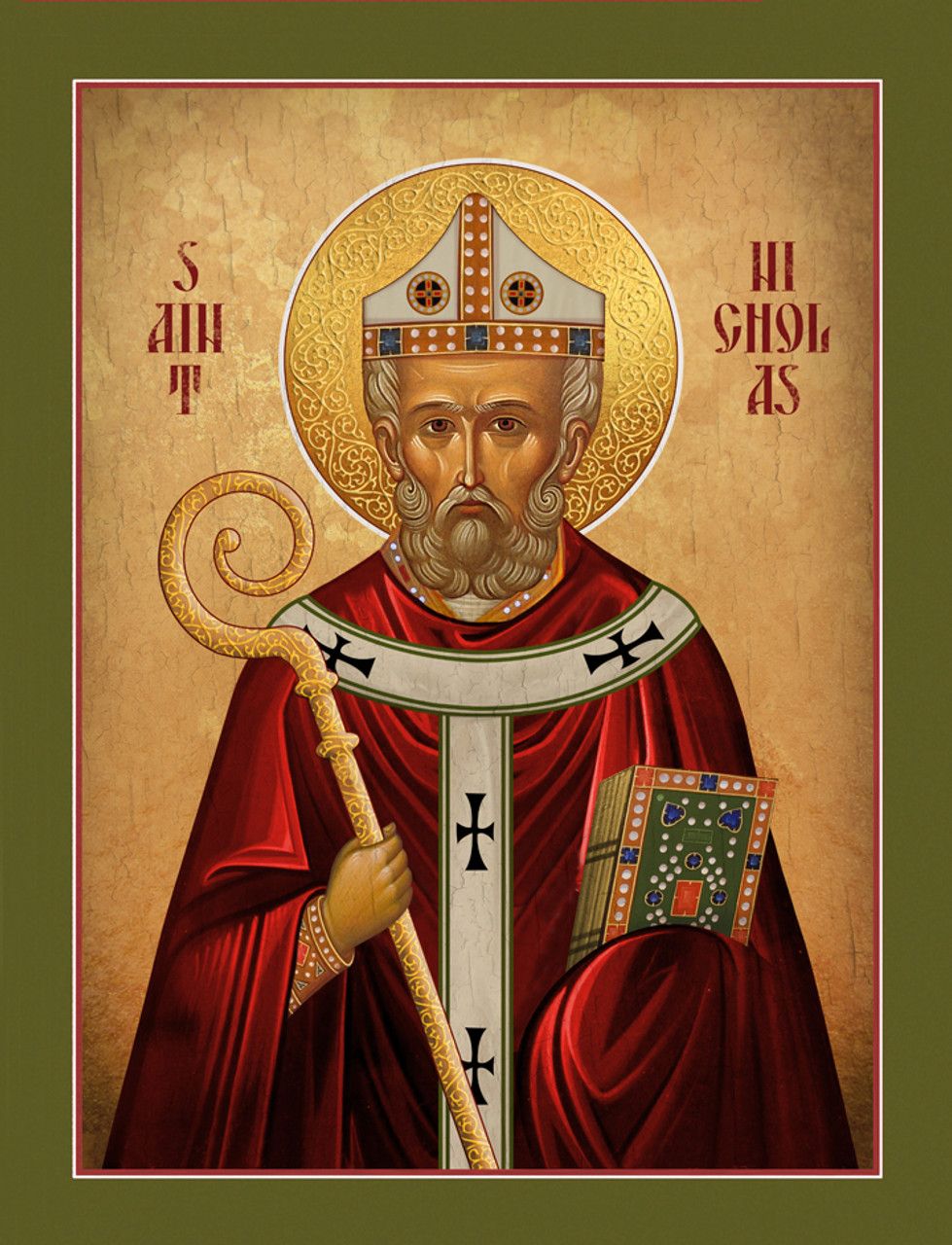
St. Nicholas of Myra
From Bishop to Santa Claus: A Catholic Perspective

Separating the Saint from the Snow
For millions, the name "Nicholas" conjures images of a jolly, red-suited figure in a sleigh. Yet, the true story is about a 4th-century bishop whose heroic virtue was so powerful that his veneration became one of the most significant in Christendom.
The Secular Figure:
Santa Claus
A magical figure from the North Pole who judges children as "naughty or nice." His giving is transactional: good behaviour earns toys.
The Catholic Reality:
St. Nicholas
A historical bishop who gave freely to the poor out of love for Christ. His giving is a reflection of Divine Grace: unmerited and overflowing.
The Historical Nucleus
The Bishop of Myra
To find the real St. Nicholas, we must look to the ancient seaport of Patara in modern-day Turkey. Born to wealthy parents in the 3rd century, he was orphaned young during an epidemic.
He took the words of Jesus literally: "Sell what you own and give to the poor." He used his entire inheritance to assist the needy anonymously. He eventually became the Bishop of Myra during a time when Christianity was strictly illegal in the Roman Empire. Under the "Great Persecution" of Emperor Diocletian, churches were destroyed and clergy were hunted. Nicholas was imprisoned and tortured for refusing to renounce Christ, earning the ancient title "Confessor" for his suffering, before eventually being released when Emperor Constantine legalized the faith.
"He lived no longer for himself but for others."
The Wonderworker
Legends of Protection and Providence
The Three Dowries
The most famous story tells of a nobleman in Patara who had lost his fortune. His three daughters, lacking dowries, faced the horrific prospect of being sold into slavery or prostitution. Nicholas, who had just inherited his own family's wealth, resolved to save them — but in secret.
Under the cover of darkness, he returned on three separate nights, tossing a bag of gold through the open window for each daughter. On the third night, the father lay in wait and caught the young bishop. Nicholas, falling to his knees, made the man promise on his honour never to reveal his identity, wishing only for God to be thanked.
The Origin of Stockings
Legend says the gold landed in stockings hanging by the fire to dry. This act of "secret mercy" is the root of our modern Christmas stocking tradition.
The Grain Miracle
During a catastrophic famine in Lycia, imperial ships laden with wheat for the Emperor in Constantinople stopped at the port of Myra. The people were starving, but the captains were terrified to touch the cargo, as the wheat was weighed and measured for the capital.
Nicholas boarded the ships and commanded them to unload a portion for the city, promising them in the name of God that the weight would not diminish. Reluctantly, they agreed.
Miraculously, when the ships arrived in Constantinople, the cargo weight was unchanged. Yet, the grain left in Myra was so abundant that it fed the entire region for two full years, with enough left over to sow the fields for the next harvest.
The "New Elijah"
This miracle was not random; it positioned Nicholas as a "New Elijah." Just as the Old Testament prophet multiplied the widow's flour during a famine, Nicholas's intercession proved that God's providence provides sustenance that never runs dry.
Saving the Innocents
Nicholas was a fierce defender of civil justice (the Stratelatis legend). While he was away, a corrupt governor in Myra had accepted a bribe to execute three innocent men.
Nicholas rushed back to the city, arriving just as the executioner had raised his sword. In a moment of supreme dramatic tension, the Bishop stormed the scaffold and physically grabbed the naked blade from the executioner's hand, throwing it to the ground. He then untied the men and marched to the governor's palace, demanding a confession. The governor, terrified by Nicholas's holy authority, fell to his knees and repented.
Patron of Sailors
Before he was a bishop, Nicholas travelled by sea to the Holy Land to walk in the footsteps of Jesus. During the voyage, a terrifying storm arose, tearing at the sails and threatening to capsize the vessel.
While the crew panicked, Nicholas calmly prayed and rebuked the wind and waves, much like Christ on the Sea of Galilee. The storm instantly vanished. This miracle spread among mariners across the Mediterranean, leading sailors centuries later to risk their lives to rescue his relics from Myra and bring them to Bari, Italy.
Defender of the Faith
The Council of Nicaea & The Legendary Slap

Medieval depiction of the confrontation
The Crisis of Arianism (325 AD)
In the early 4th century, the Church faced its greatest threat not from persecution, but from within. A priest named Arius began teaching that Jesus was not truly God, but merely a "created being" — a supreme creature, but distinct from the Father. This heresy, known as Arianism, threatened to tear the young Church apart by denying the divinity of Christ.
Constantine's Call
After making Christianity legal in the Roman Empire for the first time, Emperor Constantine the Great, seeking to unify his empire and resolve this theological fracture, summoned over 300 bishops to Nicaea (modern-day Iznik, Turkey) for the first Ecumenical Council. It was a gathering of scars; many bishops, like Nicholas, still bore the physical marks of Roman torture from the recent persecutions.
The Incident
During the debate, Arius stood up and vigorously defended his position, singing a song that mocked the equality of the Son with the Father. Nicholas, a man of gentle charity but fierce faith, could not bear the blasphemy. According to the famous legend, he rose from his seat, strode across the council floor, and struck Arius across the face.
Divine Vindication
The other bishops were shocked by this breach of decorum. Nicholas was stripped of his bishop's vestments (his mitre and pallium) and thrown into prison. However, that night, Jesus and the Virgin Mary reportedly appeared to him in his cell.
"Why are you here?" Christ asked.
"Because of my love for You," Nicholas replied.
They restored his vestments, signifying that while his method was extreme, his zeal for the Truth was pleasing to God. The Council ultimately rejected Arius and produced the Nicene Creed, affirming that Jesus is consubstantial (of the same substance) with the Father — the very Creed Catholics recite at Mass today.
The Words He Defended
"God from God, Light from Light, true God from true God, begotten, not made, consubstantial with the Father."
A Personal Reflection: Why I Love the Legend
To be honest, the historical probability of Bishop Nicholas actually slapping Arius is essentially zero. Historians tell us he might not have even been at the Council. However, I like to think it happened.
Why? Because it forces us to look past the "jolly old elf" and see the warrior for Truth. The modern world often sees Santa Claus as the ultimate representation of Christmas. But the reality is, you cannot have Christmas without the truth of the Incarnation.
As Charlie Brown said, 'Isn't there anyone who knows what Christmas is all about?'
"And there were in the same country shepherds abiding in the field, keeping watch over their flock by night. And, lo, the angel of the Lord came upon them, and the glory of the Lord shone round about them: and they were sore afraid. And the angel said unto them, Fear not: for, behold, I bring you good tidings of great joy, which shall be to all people. For unto you is born this day in the city of David a Saviour, which is Christ the Lord. And this shall be a sign unto you; Ye shall find the babe wrapped in swaddling clothes, lying in a manger. And suddenly there was with the angel a multitude of the heavenly host praising God, and saying, Glory to God in the highest, and on earth peace, good will toward men."
— Luke 2:8-14 (KJV)
"A creature cannot save."
Arius was denying the divinity of Christ. He claimed Jesus was just a supreme creature. But St. Athanasius — and in our legend, St. Nicholas — knew the fatal flaw in this logic: If Jesus is not God, He cannot save us. As Athanasius famously argued, a creature cannot save another creature. Only God can bridge the infinite gap to forgive sins.
The baby in the manger must be true God and true Man. That is the only reason we celebrate. Jesus took on a human nature just like us so He could save us. St. Nicholas didn't just give gifts to be nice; he gave them because he served a Saviour who was God enough to redeem us and Human enough to love us.
From Legend to Living Tradition
How Ancient Miracles Became Modern Customs
Hanging Stockings
The Correlation: This is a direct echo of the Dowry Miracle. Legend says that when Nicholas threw the bags of gold through the window, they landed in the daughters' stockings, which were hung by the fire to dry.
The Midnight Arrival
The Correlation: Why does Santa come at night? It reflects St. Nicholas's deep humility. He gave his gifts under the cover of darkness (anonymously) to ensure that the recipients thanked God, not him.
The Red Suit
The Correlation: While Coca-Cola and Thomas Nast standardized the modern look, the colour red roots back to the traditional vestments of a Catholic Bishop, who often wore red to symbolize the blood of the martyrs.
Candy Canes
The Correlation: The shape of the candy cane is not random; it mimics the Bishop's Crozier (staff). It reminds us that Nicholas was a shepherd of souls who guided his people toward Christ.
The Tradition of Gift Giving
The Correlation: Why do we give gifts at all? It is not just about toys. It is an imitation of St. Nicholas's anonymous charity to the poor. He gave to those who could not repay him, modelling the ultimate Gift of God to humanity: the Christ Child. When we give a gift in secret, we are walking in the footsteps of the Saint.
Historical Note
For centuries across much of Europe, the tradition took place on the Eve (Dec 5th) and morning of his feast day, December 6th. It was only after the Protestant Reformation that the tradition shifted to December 25th in many countries, merging the Saint's generosity with the celebration of Christ's birth.
The Metamorphosis: From Saint to Secular Icon
Nicholas serves as Bishop of Myra. He dies on December 6, circa 343 AD.
Sailors from Bari, Italy, remove his relics from Myra to save them from invaders. Bari becomes a massive pilgrimage site.
To keep the Saint purely benevolent, folklore created "dark companions" like Krampus (Alpine) or Père Fouettard (France) to handle the punishment of bad children, while Nicholas only gave rewards.
Protestants ban saint veneration. The gift-bringer shifts to the "Christ Child" (Christkindl), moving the date to December 25. The name Kris Kringle evolves from this.
The Netherlands keeps "Sinterklaas," a bishop figure who arrives on a boat from Spain (referencing the Bari connection).
Clement Clarke Moore writes "A Visit from St. Nicholas." He strips the bishop of his robes, gives him a sleigh and reindeer, and turns him into a "right jolly old elf."
Political cartoonist Thomas Nast (Harper's Weekly) draws Santa for the first time. He adds the North Pole home, the toy workshop, and the "Naughty or Nice" list.
Artist Haddon Sundblom creates images for Coca-Cola that cement the modern look: a human-sized, grandfatherly figure with rosy cheeks and a specific red suit. This image spreads globally, largely replacing local gift-bringers.
Spiritual Wisdom
What We Can Learn
Beyond the stockings and the sleigh, the life of St. Nicholas offers profound lessons for the modern Christian life.
-
The Virtue of Anonymity In an age of social media where every good deed is broadcast, Nicholas teaches us the power of hidden charity. He gave in secret so that God would be glorified, not himself. True generosity does not seek applause.
-
Courage in Truth He was not just "nice"; he was brave. Whether facing a corrupt executioner's sword or a heretic's lies, Nicholas showed that love sometimes requires fierce confrontation to protect the vulnerable and the Truth.
-
Attentive Compassion Nicholas didn't wait to be asked. He noticed the plight of the three daughters before they begged. He teaches us to have "eyes to see" the needs of others before they are spoken.

13th Century Icon (Sinai)
Did It All Really Happen?
Understanding Catholic Legend
The Historical Gap
Historians admit there is "scarcely anything historically certain" about Nicholas other than his existence as a 4th-century bishop. He left no writings, and his name is missing from early lists of Nicaea.
The stories we cherish — the Dowry, the Slap, the Grain — appear in texts written centuries after his death. Some may be conflated with other saints or expanded by medieval imagination.
The Theological Truth
Catholic scholarship views these legends as powerful "Theological Narratives." They may not be historically precise video recordings, but they function as catechetical tools that communicate spiritual truths.
The "Slap" teaches us that Dogma and Charity are inseparable. The "Dowry" teaches that Grace is unmerited. The lack of biographical facts allowed Nicholas to become a "perfect vessel," an archetype of Christian virtue that has inspired the world for 1,700 years.
The Perfect Advent Saint
"He gave gifts because he believed in the Incarnation."
By reclaiming St. Nicholas, we do not lose the joy of the season; we gain a powerful friend in Heaven. He guides us away from the commercialism of the mall and toward the profound humility of the manger.
He reminds us that true charity is hidden, that truth is worth defending, and that the Christ Child is the only gift that can truly satisfy the human heart.